
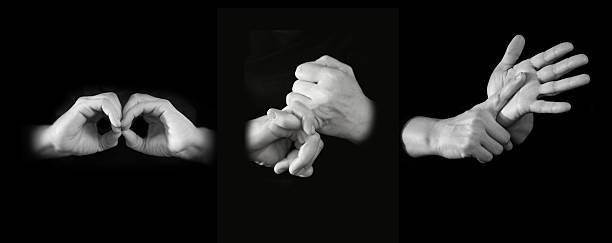
by Joe Lever
History
- 1576: First recorded use of a sign language in England (in which marriage vows were signed by Thomas Tillsye) with accounts of deaf people using signs going back even further to the 15th century
- 1720: Daniel Defoe publishes The History of the Life and Adventures of Mr Duncan Campbell, Deaf and Dumb and includes a manual alphabet chart which closely resembles modern BSL fingerspelling
- 1792: Establishment of the London Asylum for the Education of the Deaf and Dumb Poor – the first public Deaf school in Britain
- Teaching of Deaf children remained focused on speaking/writing and lip-reading, rather than encouraging signing, until the early 20th century – during this time, sign language was passed down through ‘covert’ communication between Deaf people outside of schools
- 1971: British Deaf and Dumb Association rebrands as British Deaf Association (BDA)
- 1975: First coinage of British Sign Language as the term for language used by Deaf speakers
- 1995: Disability Discrimination Act is passed
- 2003: BSL recognised as an official minority language by the British Government
Source: ‘History of British Sign Language’ exhibit www.ucl.ac.uk/british-sign-language-history
Facts
- Sign languages are not universal but instead unique to individual communities / nations
- There are regional variations within BSL just as with spoken English
- Sign languages are not direct manual versions of the spoken language – they require their own grammatical systems to most efficiently utilise hand signs
- Sign Supported English (SSE) is an alternate form of BSL which uses the same signs but in the same order as spoken English – often used with children learning BSL and spoken English grammar simultaneously
- BSL is used by over 150,000 people in the UK – of which around 85,000 are Deaf and rely solely on BSL to communicate with others
- For every Deaf person using BSL, there are on average 1.4 hearing people using BSL
- BSL is more than just hand gestures – it requires handshapes, facial expressions, gestures and body language to convey meaning and distinguish between similar signs (a bit like homonyms and homophones in written English)
- Many Deaf BSL users will also rely on lip-reading when communicating with hearing people – this has obviously been badly impacted during the pandemic
- Sign Language Week 2022 will be celebrated from March 13th-19th signlanguageweek.org.uk/
Source: ‘What is BSL?’ www.british-sign.co.uk/what-is-british-sign-language/

 The Poor Print