

by David Akanji
Welcome to AULT, the arts and culture column of The Poor Print, written by David Akanji (me). AULT exists to refocus our minds, re-engaging ourselves with art and cultural understanding. I’ll be focusing on current opinions/events/issues in the art world, but more importantly how we as students, citizens, and humans fit into it. If there are any topics or events you want covered, reach out to me at david.akanji [at] oriel.ox.ac.uk
Marina Abramović at the Royal Academy of Arts
I am sure you were all positively bedevilled by Halloween spirits and ghouls in the absence of AULT last fortnight. However, never fear because along with the Christmas miracle of incarnation comes the return of the recurrent AULT column to make you all fit and righteous to enter into His holy kingdom, at the end of it all.
When one thinks of performance art, Marina Abramović is probably the first name to come to mind. Abramović is a maverick of her time, shining a light on performance, pain and the human body during the prudish time of the 1970s.
Her exhibition at the Royal Aacdemy of Arts (RA) has been in the works since before the pandemic and brings together an intentional catalogue of Abramović’s creative journey for the first time in the UK. Most poignant are her pieces of work with her long-term partner Ulay (they are no longer together – I urge you to read the painful peregrination both of them took to the Great Wall of China; it was a journey of doomed love. Shakespeare could never). Abramović’s work creates a new definition of brave and defiant. Her piece Rest Energy (1980) shows her and Ulay holding each side of a nocked bow and arrow. Ulay draws the sting and Abramović holds the grip, with the arrow pointed at her heart. They rest against each other’s weight, drawing the string tighter. It is an exercise of trust, love and luck. Microphones amplify the rhythmic sounds of their hearts, creating the most intense four minutes ever.
Abramović has burned herself, cut herself and drugged herself all to push herself to her limits – through this ‘honest’ art is created.
Many of her pieces depict herself in the nude directly connecting her ‘energy’ with surfaces and the audience. In her piece Art Must Be Beautiful (1975) she stands naked, brushing her hair for over fifty minutes, repeating the words ‘art must be beautiful’. This piece was a catalyst for ’90s feminist performance pieces exploring the male gaze, expectations of a woman and the ineffable understanding of ‘beauty’. In her curator’s talk at the RA she highlights that her work has nothing to do with gender: ‘there is no gender’, she says. In her intimate pieces she is not exploring what it means to have secondary sexual features, she is exploring the body – as a unit. Distilled down to its interactions, its relativity in space and relations with other objects, her truth remains sound – ‘there is no gender’.
One of the fundamental beliefs of Marina and the Abramović method is that good art must involve pain. While Abramović provides some exemptions to this, it is something that remains central to the Abramović method. It is only through pain that we can push our bodies to their limit and create honest and relatable art.
However, how outdated is this philosophy? It is akin to the word of Chesty Puller: ‘pain is weakness leaving the body’. In a century when we are constantly striving to adopt softer lifestyles and conveniences, does this take from our own connection with our bodies? Is it as simple as toughening up? What about palliative care and medicine? Is the only way to mind-body restitution through pushing our boundaries and limits of pain?
Marina Abramović’s exhibition runs from 23 September 2023 to 1 January 2024 at the RA Main Galleries, Burlington House, London.
Rhythm 0 (1974)
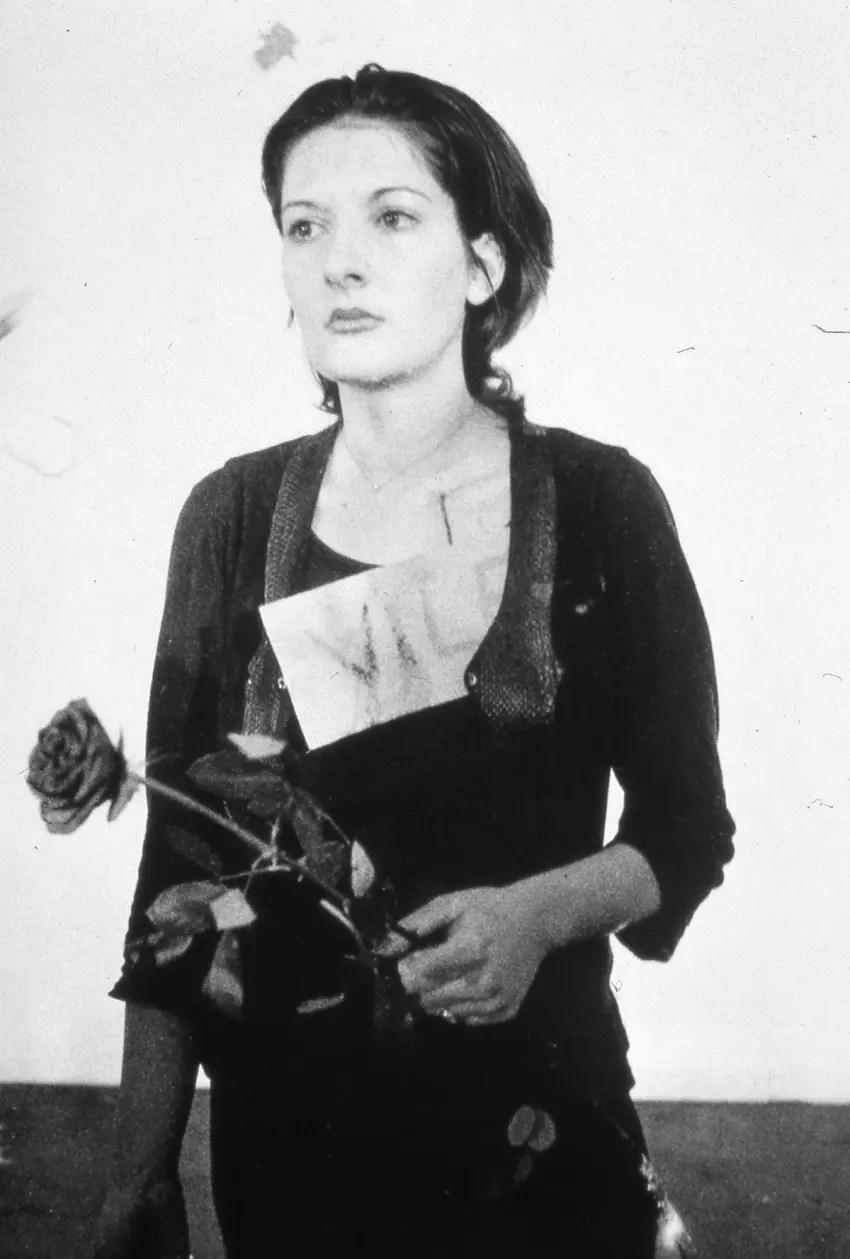
© Marina Abramović Photograph: Donatelli Sbarra

 The Poor Print