
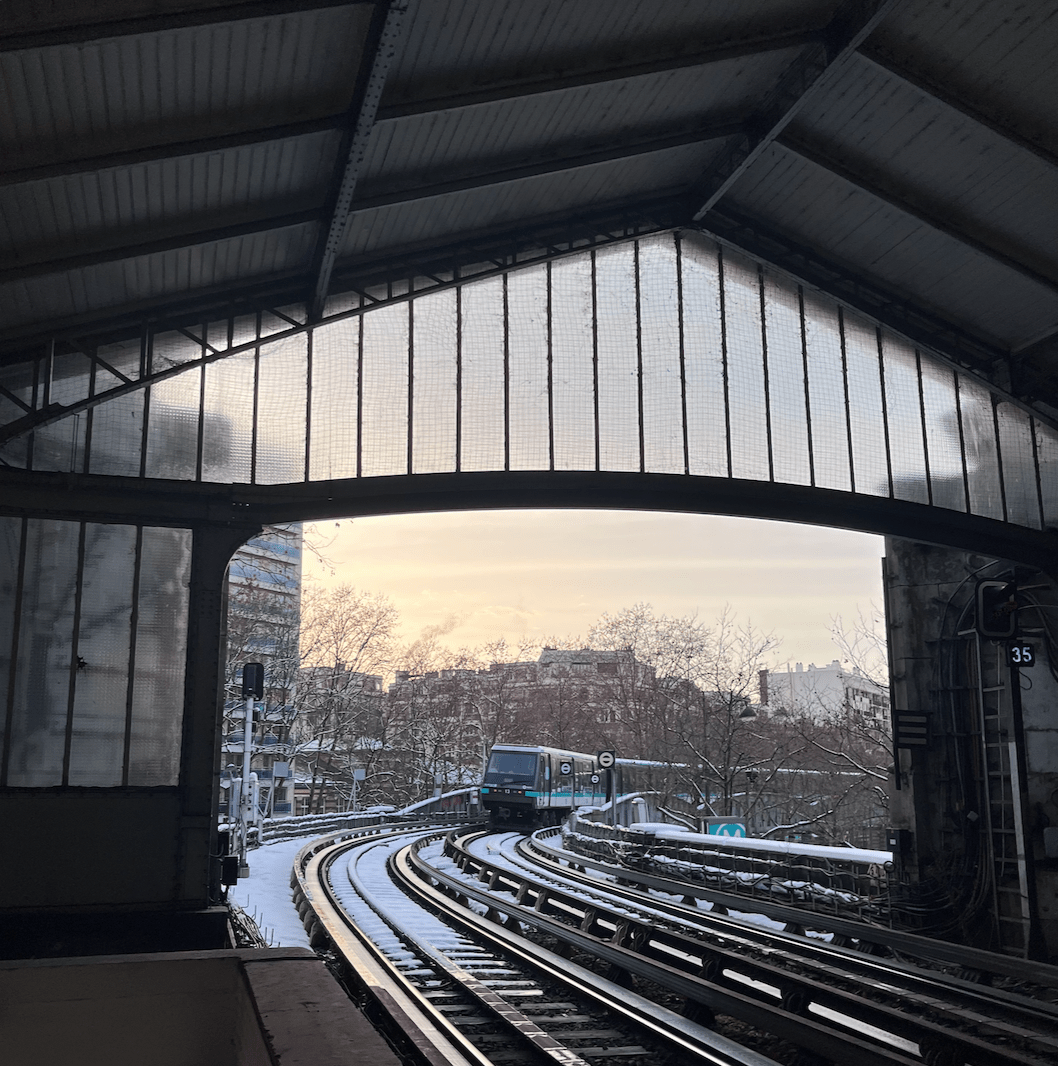
by Mark van Eykenhof
Stan held tightly onto the railing as he crossed the threshold into the corridor at the end of the fifth carriage, careful not to let the cotton of his trousers get caught in the vestibule doors. He felt awkwardly conscious of himself as he hovered in the gap between the seats and the exit. In moments prior, he had shuffled his way up the carriage feeling the glare of passengers still seated. Sometimes he paused and gestured for them to stand but at this they stared vacantly into his eyes. He felt an uncomfortable familiarity with these moments from work, caught between asserting confidence and showing humility. Standing now in the wriggle room between the carriage and its doors he clicked his fingers, hoping to shift his consciousness away from the space he occupied. Soon the train eased to a halt and he realised that the other passengers had paid little attention to him anyway.
When at last the queue ahead began to move, Stan observed the man in front of him who seemed oblivious. Even as the other passengers drifted forwards, this gristly man loitered, his blocky head intent on the side of the carriage. Stan sensed the faces of the city-workers behind him, forward-jawed and ready to go with rimless glasses and wrinkly eyes set back like reptiles. He was in their way. The rays of their vision intensified on his back as he clutched his papers close to his chest and thought about the weekend, to throw them off. As long as no one mentioned anything to him, he knew he had done everything right. Nonetheless, in each passing second, he felt that the silence might be shot through by the voice of an angry one. Each moment mounted in pressure as it built towards either exiting the train safely or persecution from the other passengers. Stan made a gesture of ordering his papers chronologically to reduce his chances of being scathed for his unofficial role in blocking the exit.
Once he had finally left the carriage, he resolved to be more aware of those watching him. After all, it was a simple mistake of observation that had placed him between the unmoving passenger and the superactive executives. With more attention to those watching him, he could monitor their reactions and, just in case he got on the nerves of any in charge, react accordingly. Then he might not have to put up with a constant sense of misgiving.
It was as he was walking along the platform to the exit that Stan made his fatal error. With his attention fixed on the distance to avoid the security camera’s gaze, he trod on loose gravel, sliding him off his feet. In one swift moment Stan’s frame was swept from its foundations. As he stumbled forwards, he felt his normal relation with the ground collapse as he fell into it. Stan hurled headlong into the space between the train and the platform. Miraculously, he survived, and with barely a scratch. The Stan-like shape of the train’s undercarriage had stopped his fall with several points of contact and welcomed him perfectly into this narrow space. Each part of his body had been cushioned by its new groove at the exact same time, sharing the impact agreeably. Stan’s fall had rendered him diagonally reclined with his legs above his head, sticking out above the platform. Due to a mid-air turn that he had not expected, Stan’s whole body faced upwards, despite the uninteresting view that this offered. He assessed his damages, noticing that he had slotted comfortably into the area as a key into its home.
Rummaging his neck around in the space that had conveniently appeared around it, Stan felt a gleeful rush as he realised his comfort in this unusual resting place. His rest was quite quickly interrupted, however, by the fear that the cameras may have recorded his accident as a deliberate sabotage. If his recent fall had appeared to be intentional, he could face major legal proceedings at the magistrates’ court. Struggling to put together the moments leading up to his fall, however, Stan resolved to first alleviate his situation before getting too hung up on the question of his possible incarceration.
It occurred to him that he ought to make some effort to grab the attention of one of his fellow commuters to save his life, or at least to make light of the situation by way of small conversation. The train was long and there was no way the train driver had noticed the small jolt he no doubt had caused to its sixth carriage. Or was it the fifth? He turned over his entrance of the train half an hour prior and could not remember which part of the train he had boarded. This information, he decided bravely, was likely not important for his mission of self-rescue, so he forgot trying to remember.
The train, an attractive locomotive, would for certain be due to heave its hefty steel arms and leave the station soon. At the height of the busy commuting morning at a central station, the train would doubtlessly be greased to full capacity. A work horse. In a matter of minutes, if that, the train would have been emptied of its passengers and the station would be urging others in to fill the space.
He considered sighing in fear. The train whistled a chord of smoke. The conductor held onto the handrail and swung outwards like a child imitating a plane from a pole. The train was about to leave and Stan was wedged under it. He hoped to avoid the imminent and crushing death of his being mangled like sticks with some virtuous labour; perhaps he could do the train a service and work as an arm until the next station. In return for saving his life he could become a part of it for a little while – yes, that could be his unofficial contract with the train. But Stan knew this was not how pretty trains worked.
He returned his attention to the platform above. So far he could only hear the clacking and scraping of boots on the ground as commuters descended from the platform into the city. As the boots thinned, he felt a sudden dread that his situation might go unnoticed. If no one were to pay attention to him as they walked past him, boldly upturned in this gap, then how would they ever stop and pick up a newspaper to read about it? It quite simply would not be worth reading in the newspaper.
One such passer-by had the elegantly polished boots of a policeman. They were absolutely dashing, Stan thought. But as he was admiring the leather sleek that edged down the ankle, it crossed his mind that they might actually be ice skates. Why a civil servant was wearing ice skates on tarmac he could not tell, but when he turned to look again the man had left his field of vision.
He wondered for a moment why this policeman, given that it was his duty to protect the best interests of the goodly citizen, had not stopped to offer him help. Had Stan’s expression been too naively absent as he was distracted by the man’s footwear? He let his attention fall from the shoes of his fellow passengers as the question put him in a state of thought. Suddenly it occurred to him that the officer must be commuting into work. He was off-duty for the time being. Stan realised his own silliness and was about to slap himself naughtily on the wrist, but for his position could not touch his hands. His hand, as if by habit, made a gesture of flicking the ends of his fingers a few centimetres: a small movement, he was aware, but in this instance it was the intention that mattered most.
Stan shifted his head around trying to find a sightline to gather the eyes of a passer-by. More suitably positioned, he could do a little jig, roll his eyes or ironically clack his knuckles together in a dancing fashion as if he was knitting — this last trick was of particular success in his college years. But since it had already taken him the best part of half a minute to rustle space for his head, it was unlikely that this premium would be granted the rest of his body in time enough to perform a dance.
Stan let his head fall and rest comfortably on the blackened railing of the iron bar connecting the train’s wheels and let out a sigh. The metal clicked slightly as he rest his head on it, but seemed not to mind. He opened his eyes to find directly in his view an empty red packet of crisps, chucked and scrunched on its ledge atop rock chips. Poor crisp packet, he thought. He might be able to alleviate his situation still, even as the last shoes exited the train, but this crisp packet might never be removed from its cavern under the platform until the wind would take it up for a little excursion in the sky and lay it down in another sad place. It might land in a bin, he thought, with another gleam of hope crossing his mind and maybe also his face. He then remembered having read that most crisp packets of this kind would never enjoy such an end.
Catching himself in a train of thought about how he might leave his job to take up a senior position in waste management, he reprimanded himself and decided to commit his remaining energy to removing himself from the gap into which he had unfortunately fallen.
Stan diverted his attention to his legs still reaching out from above the platform like the gorgeous legs of a city model. He wondered if, had he pursued work in that industry, he might have been able to fashion his legs artistically and earn the attention of one of the artists walking past. He might even be able to attract the eyes of one from another platform! It was too late for that now. Instead, realising that he had limited movement in his right leg, he moved it rhythmically from side to side, making a clinking sound against the carriage’s lower rampart. During this motion he wondered if it had been a good idea after all to perform a dance but was interrupted by a comment made by a writer walking past.
‘I was considering giving you a compliment about your rosette,’ she said, ‘but I was confused as to how it was that you knew I was a writer.’
‘I would have been delighted to receive a compliment from someone so finely attuned to the details of appearance and the devotion behind closed doors that they subtly imply,’ he said. He ignored the unnatural predicament of his knowing her profession.
An awkward silence followed in which neither party knew whether to take up the other on their observations. A pigeon struts past looking for traces of bread.
‘Such beautiful flowers,’ he said
He then realised that she was not carrying flowers but a fountain pen made from the foraged wood of an old warship, and a pad of lined paper. He swallowed to handle the awkwardness but forgot if the saliva would go up or down in his current position and, fearing the further awkwardness of choking, just blinked instead.
‘Thank you,’ she replied.
‘I suppose I ought to give you a hand’
‘That would be absolutely fantastic,’ she said.
‘You must admit that it’s a strange phase though’
‘A strange what?’
‘A strange phrase. Giving a hand seems to suppose that you aren’t expecting to receive it back afterwards. With three hands I think I’d run off and train to become a wonderful pianist in Europe. Or maybe a flautist. You might call me selfish but in all honesty I wouldn’t think twice about what might be possible with one extra hand. Perhaps lend is a better word.’
‘Yes, quite.’
He suddenly realised that all his efforts had been a massive waste of time and felt a huge wave of disappointment in this moment overcoming him. He castigated his own useless efforts in freeing himself for the stress that he felt to get to work now mounted upon him like the weight of a freight. He had already devoted intense efforts to extricating himself and would have to expend more still for the unexciting reward of being standard again. Stan’s situation, now negatively reclined, required even more work just to lift himself back to normality.
Whilst he was muttering at himself for allowing his life every-day to be so wrought with tension, Stan’s jealous coworker strode smarmily up behind the lady in an attempt to steal her away from him. The coworker positioned himself on the other side of her such that he could stare down upon her body and then upon Stan’s. I don’t want to hear your silly voice in my mouth, Stan thought.
Stan could already feel his coworker’s generous rhetorical comments and ostentatious ways taking hold of the polite nature of his recent acquaintance and he felt himself ebb into the background of the scene. Rage overcame him. If he had everyday put up with this man’s unbecoming ways just to finally earn some attention when it mattered the most then how could he lie there at a near-forty five degree angle and allow the scene to glide away into the city. He knew that the moment they turned the corner his coworker would divert his efforts elsewhere, maybe making a comment about the range of coffee shops on offer at the station before darting towards the corporate district.
In his anger he blurted out loudly in the direction of his coworker ‘you know you really ought to finish reading that second booklet that was ordered of all associates in our department. For the second consideration we are all supposed to have directed our attention not only to external resourcing concerns but also to the distribution of our own efforts. I hope you don’t mind my bringing this up now but I feel that we might both be held accountable if we were to appear to falter in the presence of business interest, even if another such colleague as myself might be able to make a convincing case for our preparation. If it’s any consolation, I don’t suppose it’s the work they care about so much as how we can talk about it in a way that is persuasive, and may in turn be able to persuade others to believe the same if we need bring in more third parties to complete the process.’
His agreed smiling with a gentle nod before continuing his conversation with the kindly writer.
‘You can’t call yourself a good businessman for being overly suspicious of hideous men and pretty women in the trade,’ Stan declared.
The coworker took a step to the side and addressed him directly, this time with a concern in his brow that for the first time in minutes made Stan feel as if he might actually be involved in the exchange.
‘I have my ways,’ he said presumptively. Perhaps he was thrown off by Stan’s pointed observation.
Feeling obliged to get to work before Stan could undo his fall and reach the office, his coworker made sudden haste to leave. He blew a generous kiss before turning on his shiny heels and swinging his briefcase to and fro excitedly. For a moment, Stan wasn’t sure whether this gesture was supposed to be an ironic stroke at himself, a flirtatious token towards the lady, or directed towards the train. It was, after all, a beautiful locomotive. The primary colours of a bird painted onto the antique structure of an enduring wooden frame. Like a retro-kitsch Trojan horse, but utterly lovely.
With his colleague now leaving, Stan huffed to himself. He had never been late to the office before and now his pathetic rival would march into the office and announce his absence. He would be conniving about it, quietly beginning murmurs supposing his late-coming in the morning before gradually letting frustration spill out over coffee. Colleagues passing in the corridor would tip their hats to one another but have a look in their eyes that voiced a growing dislike of his selfish absence. As time passed, the echoes would spread around the room until everyone was talking about his disappearance and all at once. The great rabble would be so carefully engineered that it would mingle with hatred and a desire to remove him from the office forever. The place would roar with sounds clattering, pens thrown and mugs clinking on the table as they were put down carefully after a sip. Shouting overbearingly, the colleagues that he had devoted years to maintaining a passable everyday bond with would suddenly turn on him like rodents on the weak and he’d find himself rudely ousted before he could even make a case for himself.
His anxiety intensified realising that they might send someone to his house to question his absence, but he soon remembered that people of his position were in ready supply in the city and it would be much less hassle to go next door and offer a minorly better salary to their senior associate. There might even be someone already sat in his seat, clicking away at his biro and enjoying an arabica in his coffee mug, which featured an anachronistic twentieth century rockstar entering what looked like the battle of Agincourt with an electric guitar styled as a machine gun and a band of psychedelic long-haired musicians behind him chastising the soldiers casually with a strange array of emblazoned instruments.
Oh, good mug, he thought. He missed it capitally. He looked down tiredly at his hand and imagined there his mug with a decent helping of hot filter coffee within it. In his current position, it was difficult to conceive of the coffee without it spilling all over his clothes so he opted instead to imagine it on the floor next to his head, the gentle wisps of its passionate temperature caressing the surface before making their way into the sky.
‘Oh, chap? One more thing.’ He called out to his colleague.
‘Yes.’
‘What was the lyric of that song? It’s beautiful, the most wonderful melody you’ve ever heard. You’ll be alright, something along those lines. Absolutely delightful. It sounds like it was made in the sky and only by the grace of a light mist did it transfer below the clouds. It feels as if loose ends have been tied up without your attendance and now you are unrestricted and unbothered and you can float upwards with your body outstretched and your arms and legs following closely behind. Dare I say listening to it leads to a truly pleasant feeling. I really ought to be listening to that song sometime. Yes, that would be lovely.’
‘Yes, naturally,’ the colleague agreed before continuing to the station’s exit with less of a spring in his step.
Stan felt the instinct of social etiquette jolt within him as he realised that the scene had once again returned to him and the lady. He decided to make polite conversation.
‘I would hate for you to miss your coffee this morning, but I was hoping that you may be able to alert the train driver as to my current… position. Not my best moment I’m sure. But perhaps they will understand that it was by no conscious intention that I came to be here.’
Even as she looked to him again with bright eyes, he realised that the angle at which he was addressing her may be unflattering on his part. Careful to maintain her impression of him, he slowly extended his head, raising it away from his body and forwards, donning a sophisticated air in his now delicate but steadfast eyebrows. His eyes now barely perceived her over the bump of his chin and he understood that this adjustment may suggest a haughtiness, but he favoured it to the alternative. He remembered his initial idea of attracting her attention by posing and wondered if it had been such a good idea to scrap that in such haste.
‘I have been wondering what ink you fill your pen with’, he asked her, hoping that this might coalesce her attention for enough time to alert someone to tell the train driver.
She appeared not to have heard him, for she began to talk about water-based black ink when really he’d only meant to make polite conversation.
‘I tell you this with a true and honest heart’, she said, ‘I absolutely would alert the train driver but I cannot see one anywhere. If only I could find the pilot of which you talk, I would make it my first priority to speak to him. As it stands, I am thirty minutes late for an important meeting in which I am to publish a much-anticipated book. I would never place my work above someone with such good qualities as yourself, but I do not believe that my being here can restore the normality you so desire.
Stan began to nod along as she spoke.
‘With that in mind then, as you seem not to object to my final judgement, I will now attend my meeting, thereby leaving you alone in between the platform and the train. If it’s any consolation, I feel revivified by your discourse on this fine morning, though I doubt you can see the sun now as it shines atop the glass surfaces like nothing else ever before. I will consider including you in a chapter of a book to which I am currently devoting my efforts. It is not due to be completed for at least six months and after that will require editing and reviewing according to modern standards. By then I doubt we will be partial to each other’s company but please know that if you come across a chapter detailing the situation of one such as yourself in this moment then I had you and only you in my mind whilst writing it. I must take my leave now but know that you have touched a place in my heart that I do not believe has been touched for some time. Have a good day, now.’
He watched her wandering off and felt a sense of pride and warm resolution. Though conscious of his own tendency to believe too strongly in the better natures of people, Stan believed that he had engaged in honest conversation. On a normal day, had circumstances led to their briefly conversing and had he the confidence to suggest further parleying without, of course, any romantic overtones, then the two might have enjoyed a becoming acquaintance.
Caught once again in thoughts of his own making, Stan looked up one last time to catch the light of day and observed a pair of boots walking towards him.
The conductor said that this train has no further scheduled journeys for the rest of the day and continued on.
‘Will you let me cry in peace!’ he screams. Stan doesn’t see it but a flock of birds takes to the sky far away and begins to make that pointed journey south.
He soon realises that he has dramatically overreacted. But he does fancy falling into a nice sleep. Reassured by the returning image of hot coffee, his friend the crisp packet and at last not having to consider altering his situation, Stan descends into an agreeable haze. He decides to stay put and reconsider his options later, closer to the train’s scheduled departure. It was a modest Sunday, after all.
Photo by Flora Molnar

 The Poor Print